or, Adventures in Event Photography
It was my distinct privilege recently to be present at, and to be photographing, the first independent performance by the Bridge City Bombshells, Pittsburgh's newest burlesque troupe.
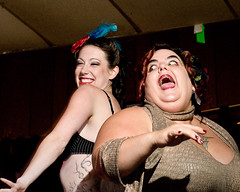
Their style is a delightful mixture of classical and modern burlesque; in their own words, "anything but ordinary." Friday's performance was jazz-themed, featuring the vocal stylings of Phat Man Dee as well as some classic recorded tracks like "I Put a Spell on You."
Elizabeth Couteau, Miss Hush, The Bees Knees, Kat de Lac, Shrimp Scanty, and the C*ntess von Tella (sorry about the asterisk, dear, but this is a family blog) each bring their own style and flavor to every number. The show featured a classic fan dance, some great character pieces including a petulant Shrimp Scanty dancing to Phat Man Dee's interpretation of "A Tisket a Tasket," and my favorite, a literally edgy interpretation of the balloon dance. The balloons already add a percussive element to your traditional striptease, but what if instead of that silly hatpin, you popped the balloons with an eight inch dagger?
And what if the balloons were filled with stage blood? Well then you'd be Tella. Stay out of the splash zone, kids.
Anyhow, about the photography. This was a very straightforward performers-on-a-stage kind of gig. Belvedere's is a dive, with lighting as low as the drink prices. I can't really complain, but I needed a little bit of reinforcement if I wanted sharp images of moving people. What I ended up doing was putting my SB-800 in remote mode, choosing a low power level and a pale amber gel to balance with the ambient light, and setting it on top of the PA speakers at stage right. The angle was consistent with stage lighting, so you don't look at the pictures and immediately think "flash."
Tuesday, July 28, 2009
Friday, June 19, 2009
Gee, that looks complicated
When I think back on using print film, or even more so, slide film, and how careful you had to be to meter everything just right, and how each time you pushed the button you spent money on tangible consumable things, there's that impulse to complain about how digital is "making photography too easy" or something.
But then you read something like this and realize that kids my days didn't realize how easy we had it either: How do you make a collodion negative?
Labels:
musings
Monday, June 15, 2009
Saturday, in the park
Oglebay Park, in Wheeling, WV to be specific. Through the magic of the internet, and no small amount of planetary harmonic convergence, I ended up working as second shooter to the wonderful Heidi Good, a Wheeling native now living and working in New York City. It was her role to tell the story of the couple's happy day, so I won't do that here. Instead I'll talk about me. This is, after all, a blog.Heidi is the kind of wedding photographer I want to be when I grow up. What I mean is, her whole attitude is one I find so appealing. Wedding photography is about dropping into someone's life on That Most Important Day, then, ideally, leaving them with a record that will be meaningful and enduring, reminding them of all the things that made the day special. Retelling the story, as it were. It's not about a number of hours of coverage, or a number of pictures, or even a book or album; those products emerge from the process of entering the family's world and documenting it during the time you have together.
It was a long day of hard work, but so very rewarding. More, please.
Labels:
weddings
Wednesday, June 10, 2009
Saturday, April 25, 2009
Be your own boss
Also, be your own accountant, and your own marketing department, and your own sales force, and your own receptionist, and your own customer service rep, and...
Whee!
Whee!
Labels:
business
Friday, February 20, 2009
Why hire a photographer?
In this age of everyone's-a-photographer, with cameras present in an ever-increasing range of consumer electronic devices, why should you pay good money for a "pro" when anyone can take a picture?
When you hire someone to take photos of your event, or your product, or your employees, or just your smiling self, probably the most important thing you're paying for is that photographer's experience. He or she has done the wrong thing enough times that when it comes to your shoot, the Right Thing will just happen, smoothly and effortlessly. While your individual circumstances and needs for a photo shoot may be quite unique, the underlying principles of photography are not; a photographer with a solid understanding of those principles won't have to think about the basics, freeing up all of your energy for the creative process and the production of exceptional images.
Not only are you getting access to experience, you're getting access to some quality gear and an expert operator. The right lenses can allow you to approach your subject in ways you couldn't even consider otherwise. The same goes for lighting, where the difference between a good photo and a great one can come from the ability and expertise to control the light on the subject. Digital photography has eliminated film costs, but every improvement in sensor technology leads to a new (and expensive) camera body with new capabilities. If I were an economist, I'd say that you've increased fixed costs while reducing variable costs, which implies that you need to do more work with that capital equipment for things to make sense. Hiring a pro lets you throw $10,000 worth of gear at a $2,000 wedding, or even a $200 portrait session, rather than compromising on gear in a do-it-yourself scenario.
When you hire someone to take photos of your event, or your product, or your employees, or just your smiling self, probably the most important thing you're paying for is that photographer's experience. He or she has done the wrong thing enough times that when it comes to your shoot, the Right Thing will just happen, smoothly and effortlessly. While your individual circumstances and needs for a photo shoot may be quite unique, the underlying principles of photography are not; a photographer with a solid understanding of those principles won't have to think about the basics, freeing up all of your energy for the creative process and the production of exceptional images.
Not only are you getting access to experience, you're getting access to some quality gear and an expert operator. The right lenses can allow you to approach your subject in ways you couldn't even consider otherwise. The same goes for lighting, where the difference between a good photo and a great one can come from the ability and expertise to control the light on the subject. Digital photography has eliminated film costs, but every improvement in sensor technology leads to a new (and expensive) camera body with new capabilities. If I were an economist, I'd say that you've increased fixed costs while reducing variable costs, which implies that you need to do more work with that capital equipment for things to make sense. Hiring a pro lets you throw $10,000 worth of gear at a $2,000 wedding, or even a $200 portrait session, rather than compromising on gear in a do-it-yourself scenario.
Labels:
business
Subscribe to:
Posts (Atom)